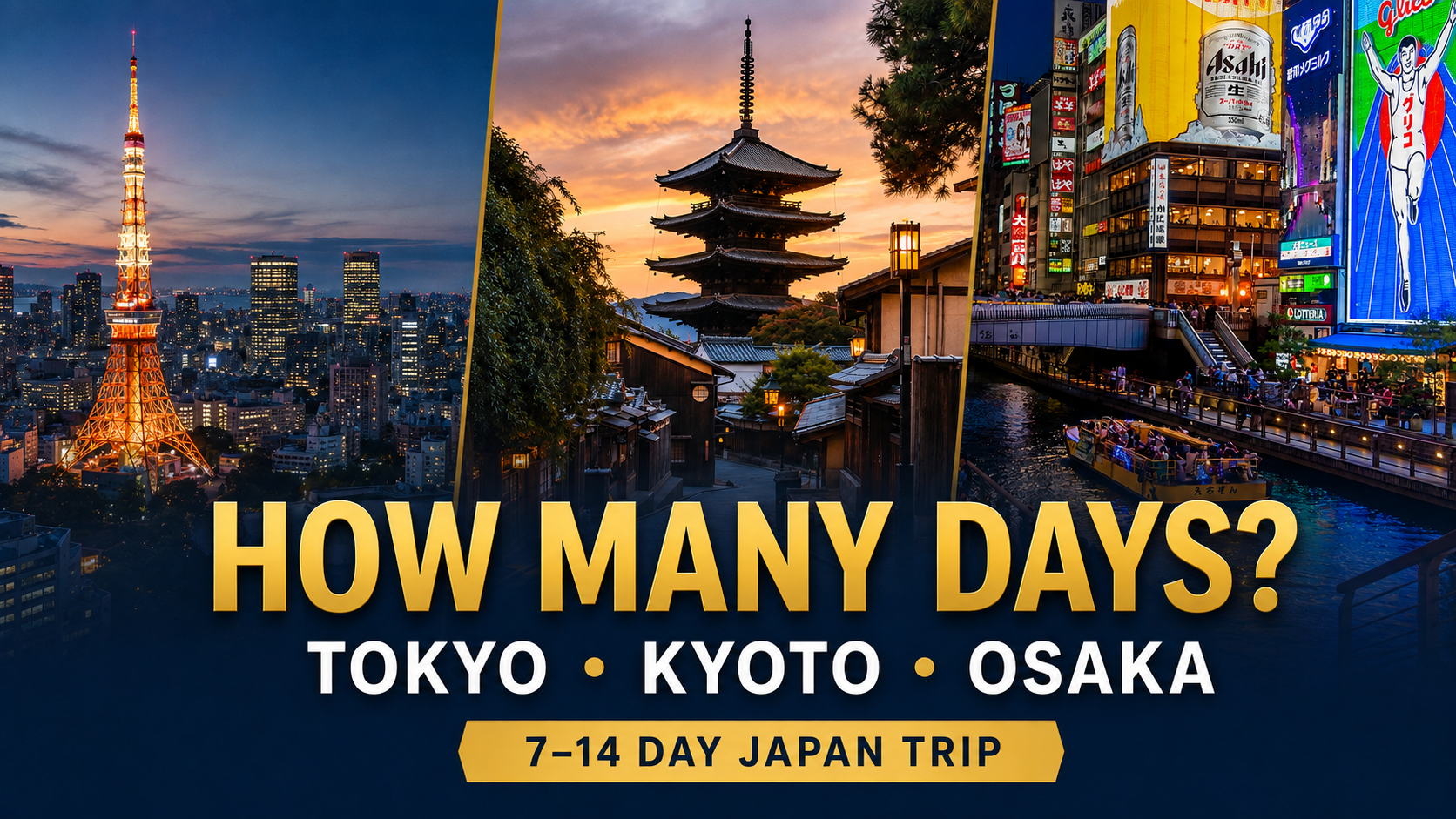
Planning your first trip to Japan often starts with a simple question:
How many days should I spend in Tokyo, Kyoto, and Osaka?
There is no single correct answer.
Tokyo, Kyoto, and Osaka can all be included in many first-time Japan itineraries, but whether that works well depends on how much time you want in each place—and what else you want to add.
A better question is:
What do you gain by adding another stop, and what do you have to give up elsewhere?
Adding Hakone, Hiroshima, or another destination does not only use sightseeing time. It can also mean more intercity travel, another hotel change, more luggage handling, and a faster overall pace.
So instead of trying to fit in as many places as possible, use this guide to decide which stops are worth the trade-off for your trip.
Quick Answer
Do not decide your Japan itinerary only by the number of days you have. Start with the places and experiences you care about most, then compare what you gain from each extra stop with the sightseeing time, travel, hotel changes, and pace you give up elsewhere.
Around 7 days, extra stops can quickly compress your main cities. Around 10 days, places such as Hakone or Hiroshima become easier to consider. Around 14 days, you have more flexibility—but spending longer in fewer places can still be the better choice.
Decide What You Do Not Want to Miss
Before deciding how many days to give Tokyo, Kyoto, or Osaka, identify what matters most to you.
If Kyoto is one of the main reasons you are visiting Japan, cutting a large part of your Kyoto time just to add another famous destination may not improve your trip.
If Tokyo is your priority, you may prefer to keep more time there rather than continually moving between cities.
And if a particular experience in Hakone or Hiroshima is high on your list, accepting additional travel may be completely reasonable.
The important point is this:
Your itinerary should reflect your priorities, not a fixed number of days recommended by someone else.
Before adding another stop, ask:
If I have to remove half a day or one full day somewhere else, where would I be most comfortable losing that time?
If there is no clear answer, your itinerary may already be full enough.
How the Trade-Off Changes With 7, 10, or 14 Days

There is no rule that says you should visit a certain number of cities based only on the length of your trip.
But the cost of adding another stop changes as your available time changes.
About 7 Days
With around one week, adding more destinations can quickly compress the time available in your main cities.
You may be able to visit Tokyo, Kyoto, and Osaka, but it is still worth comparing that plan with:
- leaving one city out,
- removing a day trip,
- or spending more time in the places you care about most.
The key question is not:
Can I fit everything in?
It is:
Will I still have enough time in the places that matter most to me?
About 10 Days
Around ten days gives you more room to consider a stop such as Hakone or Hiroshima.
But that extra stop still has to come from somewhere.
If you add one night in Hakone, for example, you may reduce your time in Tokyo, Kyoto, or Osaka. You may also add another hotel check-out and check-in.
So do not simply add a fourth destination to the calendar.
Decide exactly what you are removing to make room for it.
About 14 Days
With around two weeks, you have more flexibility.
But more days do not automatically mean more destinations.
You can also use the extra time to:
- stay longer in Tokyo or Kyoto,
- add day trips without changing hotels,
- leave some flexible time,
- or travel at a slower pace.
A longer trip with fewer hotel changes can be just as reasonable as one that includes several additional destinations.
Before Adding Another Stop, Check These Five Things
When you are considering Hakone, Hiroshima, or any other extra destination, use the same five-step check.
1. What Do You Gain?
Start with the reason you want to add the place.
Do not add a destination simply because it appears in many Japan itineraries.
Ask what you actually want from it.
Is there a specific experience you would regret missing?
Or is it mainly another famous place that seems possible to fit into your schedule?
The stronger the reason, the easier it may be to justify the extra travel.
2. What Do You Give Up?
Every extra stop replaces something else.
If you add one night in Hakone, does that mean one less night in Tokyo?
If you add Hiroshima, are you reducing your Kyoto time?
If you add another day trip, are you removing your only flexible day?
Do not evaluate the new destination by itself.
Compare the itinerary before and after adding it.
3. How Much Travel Does It Add?
Intercity train time is only one part of a transfer.
For example, Tokyo Station to Kyoto Station takes about 130 minutes by direct Tokaido Shinkansen.
But your real travel block also includes getting from your hotel to Tokyo Station and from Kyoto Station to your next hotel or destination.
Waiting time and station navigation can add more time as well.
A journey that looks like “about two hours” on a timetable therefore occupies more than two hours of your travel day.
Use train times as a useful reference—not as the complete amount of time you will spend changing cities.
4. Does It Add Another Hotel Base?
The number of places you visit does not have to equal the number of places where you stay.
Kyoto and Osaka are a useful example.
Kyoto Station to Osaka Station takes about 30 minutes by JR Special Rapid Service.
So visiting both cities does not automatically mean you need to change hotels between them.
You could:
- stay in Kyoto and visit Osaka,
- stay in Osaka and visit Kyoto,
- or stay in both cities separately.
Each choice has a different trade-off.
Changing hotels can reduce repeated intercity travel, but it adds packing, check-out, luggage movement, and check-in.
Keeping one hotel base avoids the hotel change but adds a return journey.
Neither option is always better.
Choose Your Hotel Area Next
Once you know which cities you want to stay in, compare the best areas before choosing a hotel.
- Where to Stay in Tokyo for First-Time Visitors
- Where to Stay in Kyoto for First-Time Visitors
- Where to Stay in Osaka for Sightseeing and Trips to Kyoto
5. Does the Pace Still Suit You?
An itinerary can be technically possible and still be wrong for you.
Some travelers enjoy moving quickly and seeing many places.
Others prefer spending more time in fewer locations.
After adding the new stop, look at the entire trip again.
Are you changing hotels every one or two nights?
Are many days built around transfers or fixed reservations?
Do the destinations that were originally most important to you still have enough time?
If the new version looks less enjoyable overall, the extra stop may not be worth the trade-off.
Example: Should You Add Hakone?
Hakone is a useful example because adding it changes the structure of a Tokyo–Kyoto trip.
From Shinjuku Station, a direct Romancecar to Hakone-Yumoto takes about 80 minutes.
If you stay overnight in Hakone and then continue toward Kyoto, you generally travel back toward Odawara and connect to the Tokaido Shinkansen.
Compared with traveling directly from Tokyo to Kyoto, you are adding another destination and another hotel base.
That can make sense if Hakone is an important part of your trip.
For example, you may value a ryokan stay or onsen experience more than an extra day in Tokyo.
But if Hakone is on your list mainly because it appears in many first-time itineraries, compare it directly with the time you would lose elsewhere.
You can also visit Hakone from Tokyo without adding another hotel base.
That avoids another hotel change, but it puts the outward and return travel into the same day.
The useful question is not simply:
Is Hakone worth visiting?
It is:
Is Hakone worth the specific travel time and sightseeing time I have to give up to include it?
Example: Should You Add Hiroshima?
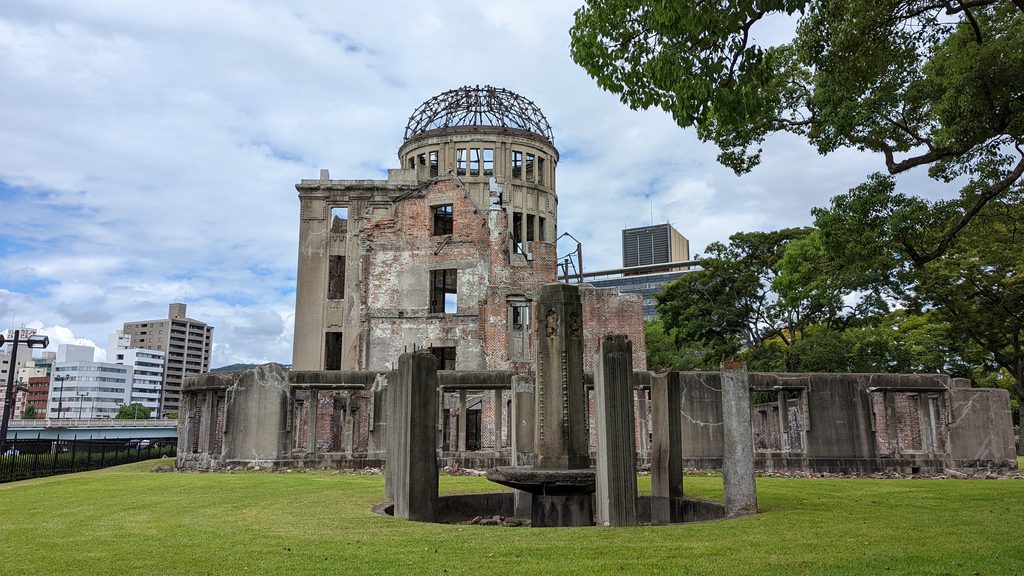
Hiroshima creates a different trade-off.
From Kyoto Station, a direct Shinkansen can reach Hiroshima Station in around an hour and a half or more, depending on the train.
That makes Hiroshima possible to include from Kansai, but a day trip still uses several hours on intercity rail alone.
If you also want to visit Miyajima, the journey does not end at Hiroshima Station. Additional local rail travel and a ferry are needed to reach the island.
So compare two versions of your trip.
In one version, you keep that time in Kyoto or Osaka.
In the other, you use part of it for Hiroshima and possibly Miyajima.
If Hiroshima is one of your strongest interests in Japan, the trade may be easy to justify.
If it is a lower-priority destination, you may prefer to keep that time in Kansai.
Staying overnight in Hiroshima can spread the intercity travel across different days, but it also adds another hotel base.
Again, the goal is not to decide whether Hiroshima is universally worth visiting.
It is to decide whether Hiroshima is worth what you personally have to remove from the rest of your trip.
A Simple Way to Decide Your Own Itinerary
When you are unsure whether to add another stop, use this process:
- List the places and experiences you care about most.
- Add the destination you are considering.
- Decide exactly what you will remove to make room for it.
- Add the extra travel and any hotel change.
- Compare the two versions and choose the one you would rather experience.
This works whether you have seven days, ten days, or two weeks.
A good itinerary is not the one with the most destinations.
It is the one where the places you care about most still have enough time.
If you cannot clearly identify what you are willing to give up for another stop, that may be a sign that your itinerary already has enough in it.
Next: Choose Where to Stay
Once you know which cities belong in your itinerary, choose the area that best fits how you want to travel.
- Where to Stay in Tokyo for First-Time Visitors
- Where to Stay in Kyoto for First-Time Visitors
- Where to Stay in Osaka for Sightseeing and Trips to Kyoto
Some links on this page are affiliate links. If you book through these links, we may earn a small commission at no extra cost to you. This helps support Japan Easy Guide and allows us to continue creating free travel guides. We only recommend hotels and services that we believe are genuinely helpful for first-time visitors to Japan.