Japan is much easier to travel when your smartphone is connected.
You will probably use your phone many times during your trip: checking train routes, using Google Maps, translating signs, finding your hotel, checking tickets, and contacting your travel companions.
For first-time visitors, mobile data is not just convenient. It helps you move with confidence.
This guide explains why you should prepare mobile data before arriving in Japan, why eSIM is usually easier than a physical SIM card, and which eSIM options are useful for Japan travel.
This article may contain affiliate links. If you buy through these links, Japan Easy Guide may earn a commission at no extra cost to you. We only introduce options that can be useful for first-time visitors to Japan.
Quick Answer
For most first-time visitors, prepare mobile data before you arrive in Japan.
The easiest option is usually an eSIM if your phone supports it. You can buy it online, set it up before your trip, and use mobile data soon after landing.
If your phone does not support eSIM, consider a physical SIM card or Pocket Wi-Fi instead.
If you are unsure, it is usually less stressful to prepare mobile data before your flight rather than trying to solve it after arriving at the airport.
Why Mobile Data Is Important in Japan

Mobile data is especially useful in Japan because you will often use your phone while moving.
You may need it to:
- check train routes
- find the right station exit
- use Google Maps
- translate signs or menus
- show hotel or ticket information
- search for restaurants or convenience stores
- contact your hotel or travel companions
Japan’s train system is very useful, but large stations can be confusing for first-time visitors. Tokyo Station, Shinjuku Station, Shibuya Station, and major airport stations have many platforms, exits, and train lines.
Having mobile data makes these moments much easier.
You do not need to understand every train line in advance. You just need a stable internet connection so you can check your route when you need it.
In Japan, mobile data is not just convenient. For first-time visitors, it is close to essential.
Tokyo and other major cities have very dense train, subway, and bus networks. Even Japanese residents often use smartphone route apps to check the best train, platform, transfer station, and station exit.
In large Japanese stations, choosing the right station exit is often just as important as choosing the right train. At stations like Shinjuku, Tokyo, Shibuya, and Ikebukuro, using the wrong exit can add a lot of walking time.
Japan has free Wi-Fi in some airports, stations, hotels, and cafes, but you should not fully rely on it while moving around. You may need to register, reconnect, or move to a specific area to use it.
Can You Buy a SIM Card After Arriving in Japan?
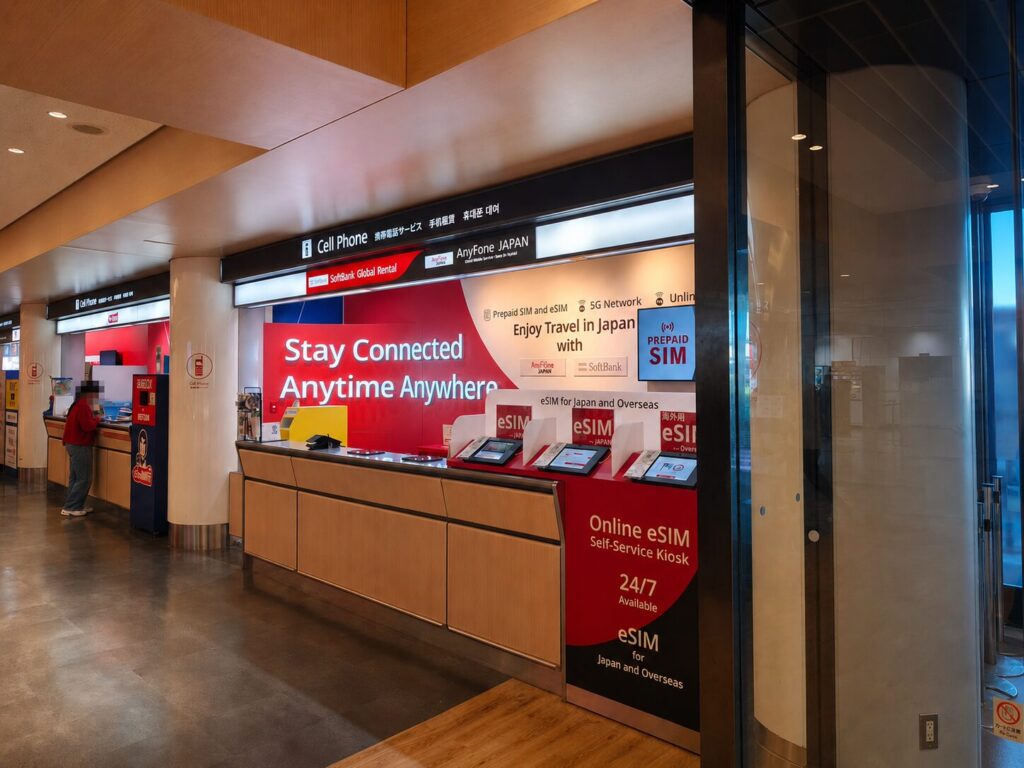
Yes, you can buy a physical SIM card at major airports such as Narita Airport and Haneda Airport. You may also find SIM card vending machines, airport counters, or electronics stores in large cities.
This can work well if your phone does not support eSIM.
However, buying a physical SIM card after arrival can be less convenient.
You may need to:
- find a SIM card counter or vending machine
- wait in line
- check opening hours
- choose a plan while tired after a long flight
- remove and store your regular SIM card
- change phone settings after arrival
For some travelers, this is not a big problem.
But for first-time visitors, it is usually easier to prepare mobile data before the flight. After landing, you can focus on immigration, luggage, transportation, and getting to your hotel.
You can buy a physical SIM card after arriving at major airports in Japan, but it may not always be the easiest option.
After arriving in Japan, several tasks often happen at the same time: getting online, finding transportation, checking your hotel route, handling luggage, and sometimes withdrawing cash.
At busy airports, SIM card counters and mobile service counters can take time, especially when many international flights arrive around the same time.
From a local Japanese perspective, it is better to reduce the number of decisions you need to make at the airport. If your phone supports eSIM, preparing it before arrival can make your first hour in Japan much smoother.
Why eSIM Is Usually Easier Than a Physical SIM Card
An eSIM is a digital SIM that you can install on your phone without inserting a physical card.
If your phone supports eSIM, it is usually one of the easiest ways to get mobile data in Japan.
| Option | Best for | Notes |
|---|---|---|
| eSIM | Most solo travelers and couples | Buy online and set up before arrival |
| Physical SIM | Phones without eSIM | May require airport purchase or delivery |
| Pocket Wi-Fi | Families or many devices | Needs pickup, charging, and return |
With an eSIM, you can usually buy a plan online, install it before your trip, and turn it on when you arrive in Japan.
This means you do not need to look for a SIM card counter after landing.
For most first-time visitors, eSIM is the simplest option if your phone supports it and your phone is unlocked.
Recommended eSIM Options for Japan
There are many eSIM services for Japan.
For this guide, I recommend keeping the choice simple. Most first-time visitors do not need to compare too many providers.
Here are two useful options to check before your trip.
Saily: A Simple and Affordable Option for Most Travelers

Saily is a good option if you want a simple app-based eSIM for Japan.
In my experience, Saily has been easy to use and provided sufficient speed for maps, messaging, and translation during my trips.In my experience, it is easy to use, affordable, and fast enough for normal travel needs such as maps, messaging, web search, and translation.
For Japan travel, Saily is a good first option to check if:
- you want to prepare mobile data before arrival
- you want a simple app-based setup
- you mainly need data for maps, search, translation, and messaging
- you do not need a Japanese phone number
- you want to avoid buying a physical SIM card at the airport
Saily eSIMs are usually data-only. This means you can use internet-based apps such as WhatsApp, LINE, iMessage, FaceTime, Google Maps, and translation apps, but normal phone calls and SMS may not be included.
【Saily】
Sakura Mobile: A Japan-Based Option for Visitors

Sakura Mobile is another option for travelers visiting Japan.
It offers travel SIM, eSIM, and Pocket Wi-Fi options for visitors. This can be useful if you prefer a Japan-based service or want to compare eSIM with physical SIM and Pocket Wi-Fi options.
Sakura Mobile may be a good option if:
- you want a Japan-focused mobile service
- you want English support for Japan travel
- you want to compare eSIM, physical SIM, and Pocket Wi-Fi
- you are staying longer in Japan
- you prefer a service designed specifically for visitors to Japan
If you want to compare Japan-based SIM, eSIM, and Pocket Wi-Fi options, you can also check Sakura Mobile’s Japan travel options.
When Should You Set Up Your eSIM?
The easiest timing is before you arrive in Japan.
Do not wait until you are tired at the airport if you can avoid it.
Purchase your eSIM before departure.
Install it while you still have internet access.
Do not activate the eSIM yet.
Turn on the eSIM after landing in Japan.
After landing, set the travel eSIM as your mobile data line and enable data roaming if the provider instructs you to do so.
If you set it up before your trip, you may be able to use mobile data soon after landing, without looking for a SIM card counter.
If it does not connect immediately, use airport Wi-Fi and check the setup instructions from your eSIM provider.
Before You Buy: Check These 3 Things
Before buying an eSIM, check these three points.
1. Your phone supports eSIM
Not all phones support eSIM.
Many recent iPhone, Google Pixel, Samsung Galaxy, and other smartphone models support eSIM, but compatibility depends on the model, country, and carrier.
Check your phone settings or the eSIM provider’s compatibility list before buying.
2. Your phone is unlocked
Your phone should be unlocked to use a travel eSIM.
If your phone is locked to your home mobile carrier, a travel eSIM may not work.
If you are not sure, check with your mobile carrier before your trip.
3. You understand that many travel eSIMs are data-only
Many travel eSIMs are for mobile data only.
This means you can use apps such as Google Maps, WhatsApp, LINE, iMessage, FaceTime, and translation apps, but you may not get a local Japanese phone number.
If you need normal phone calls or SMS, check the plan details carefully before buying.
Do not buy an eSIM only because it is cheap. First check compatibility, data amount, validity period, hotspot rules, and whether calls or SMS are included.
Common Mistakes to Avoid
Many eSIM problems can be avoided before your trip.
Here are common mistakes to watch out for.
- Buying an eSIM without checking phone compatibility
- Forgetting to check whether the phone is unlocked
- Trying to set up an eSIM for the first time after landing
- Assuming every eSIM includes calls and SMS
- Choosing only by the lowest price
- Depending only on airport Wi-Fi for the whole trip
- Forgetting to enable data roaming for the travel eSIM when required
Some travelers wait until they arrive in Japan to solve their internet problem. It is usually less stressful to prepare mobile data before departure.
Final Advice
For most first-time visitors to Japan, mobile data is worth preparing before arrival.
You will likely use your phone from the moment you land: checking maps, finding train routes, translating signs, and getting to your hotel.
If your phone supports eSIM, an eSIM is usually the easiest option. You do not need to pick up a device, insert a physical SIM card, or search for a counter at the airport.
Saily is a simple and affordable option to check first, especially if you want an app-based eSIM for normal travel use.
If you prefer a Japan-based service or want to compare eSIM, physical SIM, and Pocket Wi-Fi, Sakura Mobile is also worth checking.
The best option is not always the most expensive one. Choose the option that helps you arrive in Japan with less stress and move confidently during your first day.