Japan’s train stations can feel confusing at first.
Many stations have:
- multiple train lines
- different railway companies
- many platforms
- local, rapid, and express trains
- large underground areas
- crowded signs everywhere
But the good news is:
You do not need to understand everything.
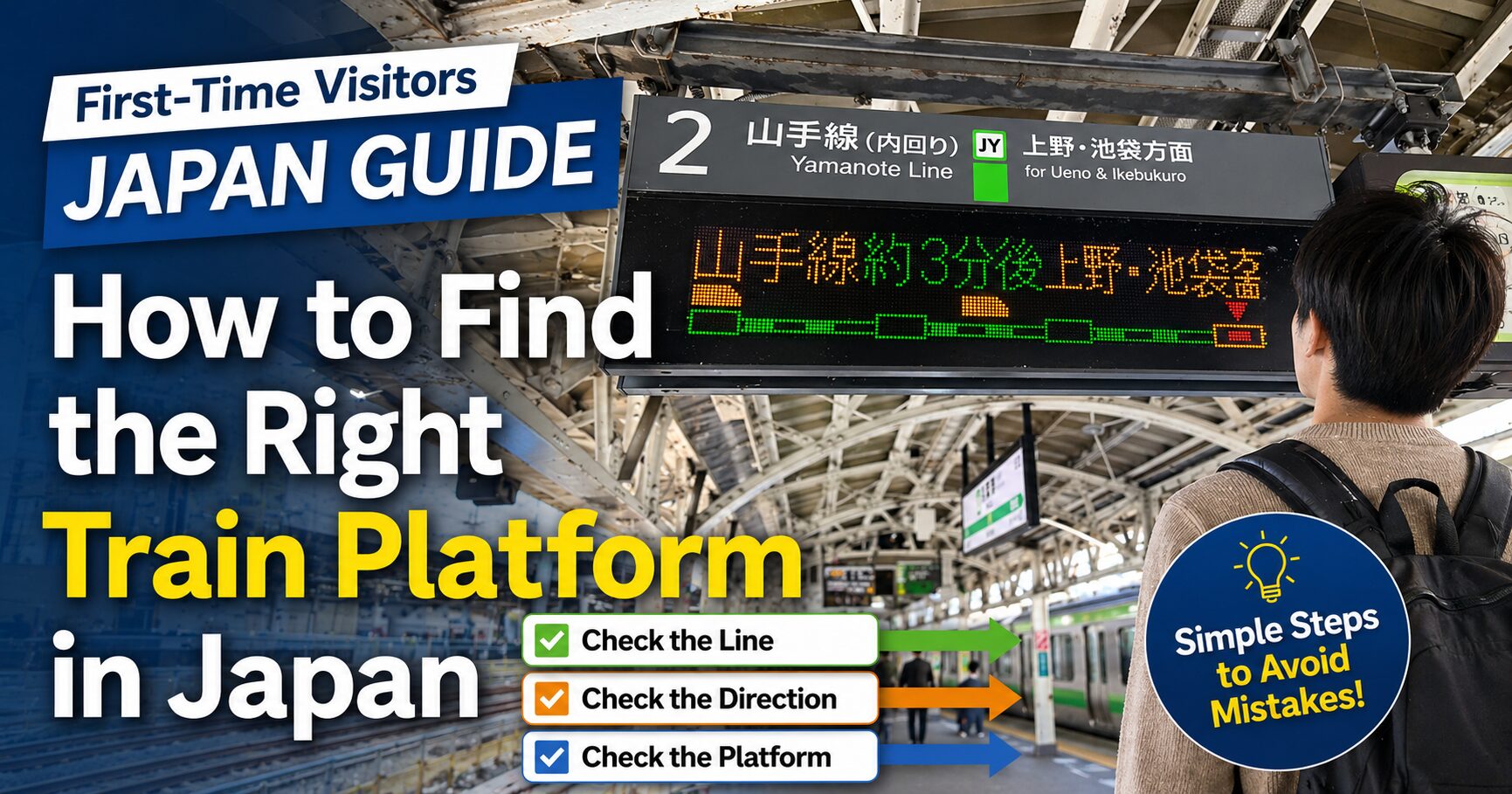
For most first-time visitors, you only need to check:
- the train line name
- the direction (destination)
- the platform number
Once you know how to check these three things, Japanese train stations become much easier.
- Quick Recommendation
- What Usually Confuses First-Time Visitors
- What to Check First
- Step 1: Check the Train Line Name
- Step 2: Check the Direction or Destination
- Step 3: Check the Platform Number
- How to Read the Departure Board
- Understanding Local, Rapid, and Express Trains
- JR, Metro, and Private Railways Are Different
- If You Are Unsure, Use Google Maps
- Common Mistakes to Avoid
- What to Do If You Get Lost
- Practical Tips for First-Time Visitors
- Related Guides
- Conclusion
Quick Recommendation
If you feel confused inside a station, do this first:
- Check the train line name
- Check the final destination or direction
- Check the platform number on the departure board
Do not try to understand the whole station at once.
Most station signs in Japan also include English.
What Usually Confuses First-Time Visitors
Many visitors get confused because:
- one station may have many train lines
- different train companies use the same station
- train types are different
- platforms may be far apart
- exits and transfer areas are large
For example, at stations like Shinjuku or Tokyo Station, there may be:
- JR lines
- Tokyo Metro lines
- private railway lines
- airport trains
- Shinkansen platforms
inside the same station area.
This is normal in Japan.
The important thing is to focus only on your train.
What to Check First
When you enter a station, do not immediately look for the platform.
First, check:
- the train line
- the destination direction
- the platform number
Usually, stations guide you in this order.
Step 1: Check the Train Line Name
First, confirm which train line you need.
Examples:
- JR Yamanote Line
- JR Chuo Line
- Tokyo Metro Ginza Line
- Keisei Line
- Narita Express (N’EX)
In large stations, different train lines go to different platform areas.
Following the correct line name is the most important step.
Step 2: Check the Direction or Destination
This is one of the most important points in Japan.
Many train lines have trains going in both directions.
For example:
- one train goes toward Shinjuku
- another goes toward Tokyo
- another goes toward Yokohama
Even if the train line is correct, the direction may be wrong.
Look for:
- the final destination
- major station names
- direction signs above the platform entrance
Example:
JR Yamanote Line (Outer Loop) for Shibuya and Shinjuku
This tells you which direction the train will go.
Step 3: Check the Platform Number
After checking the line and direction, look for the platform number.
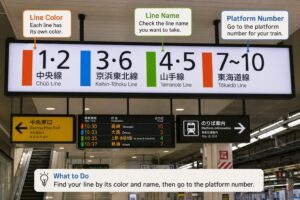
In Japan, platform numbers are usually clearly displayed.
Examples:
- Platform 1
- Track 3
- Platform 15
The platform number is often shown:
- on overhead signs
- on departure boards
- near escalators and stairs
Follow the platform number signs carefully.
How to Read the Departure Board
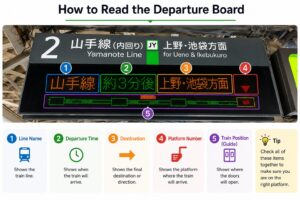
Most stations have electronic departure boards.
These boards show:
- departure time
- train type
- destination
- platform number
For example:
| Time | Train | Destination | Platform |
|---|---|---|---|
| 10:12 | Rapid | Tokyo | 3 |
| 10:18 | Local | Nakano | 3 |
The platform number is very important.
Even if multiple trains use the same platform, the departure board helps you confirm the correct train.
Understanding Local, Rapid, and Express Trains
This is another common confusion point.
On many train lines:
- Local trains stop at every station
- Rapid trains skip some stations
- Express trains stop at fewer stations
For most visitors:
- Local trains are the easiest
- Rapid trains are usually fine in cities
- Express trains need more attention
If you are unsure, check:
- whether your destination station appears on the station list
- the train type on Google Maps
- station signs on the platform
JR, Metro, and Private Railways Are Different
Japan has multiple railway companies.
The main ones are:
- JR
- Tokyo Metro
- Toei Subway
- private railways like Keisei or Odakyu
Sometimes you may need to:
- walk to another area
- pass through transfer gates
- follow a different color or logo
Do not assume all platforms are connected closely together.
Always follow:
- the line name
- the company logo
- platform signs
If You Are Unsure, Use Google Maps
For most first-time visitors, Google Maps is usually the easiest option.
Google Maps can show:
- train line names
- platform numbers
- departure times
- train types
- transfer stations
Inside the station:
- open Google Maps
- confirm the line name
- confirm the platform number
- follow station signs
This combination works very well in Japan.
Common Mistakes to Avoid
Going to the Correct Line but Wrong Direction
This is extremely common.
Always check:
- destination direction
- final station name
before entering the platform.
Boarding the Wrong Train Type
Some trains skip stations.
Before boarding:
- check the train type
- confirm your station appears on the route
If unsure, local trains are usually safer.
Following Only the Platform Number
Platform numbers may change during transfers.
Always confirm:
- line name
- direction
- platform number together
Do not follow platform numbers alone.
What to Do If You Get Lost
Do not panic.
Japanese stations may look complicated, but there are many signs and staff members.
If confused:
- stop walking
- check Google Maps again
- look for the line name
- check overhead signs carefully
- ask station staff if needed
Simple English like this is usually enough:
“Which platform for Shinjuku?”
Station staff are generally helpful.
Practical Tips for First-Time Visitors
Use IC Cards
Using an IC card like Suica or PASMO makes train travel much easier.
You can pass through ticket gates quickly without buying tickets every time.
You can read our guide here:
How to Use Welcome Suica Card in Japan
Avoid Rush Hour If Possible
Major stations become very crowded during:
- 7:30–9:30 AM
- 5:30–7:30 PM
If you are carrying large luggage, avoid these times when possible.
Check the Train Before Boarding
Before entering the train:
- check the platform sign
- check the train destination
- check the departure board
This prevents many mistakes.
Related Guides
You may also find these guides helpful:
- How to Use Trains in Tokyo for First-Time Visitors
- How to Use Welcome Suica Card in Japan
- What First-Time Visitors Should Do After Arriving at Narita Airport
- How to Withdraw Cash from ATMs in Japan
Conclusion
Japanese train stations may look complicated at first.
But in most cases, you only need to check:
- the line name
- the direction
- the platform number
Do not try to understand the whole station.
Focus on one step at a time, and train travel in Japan will become much easier.